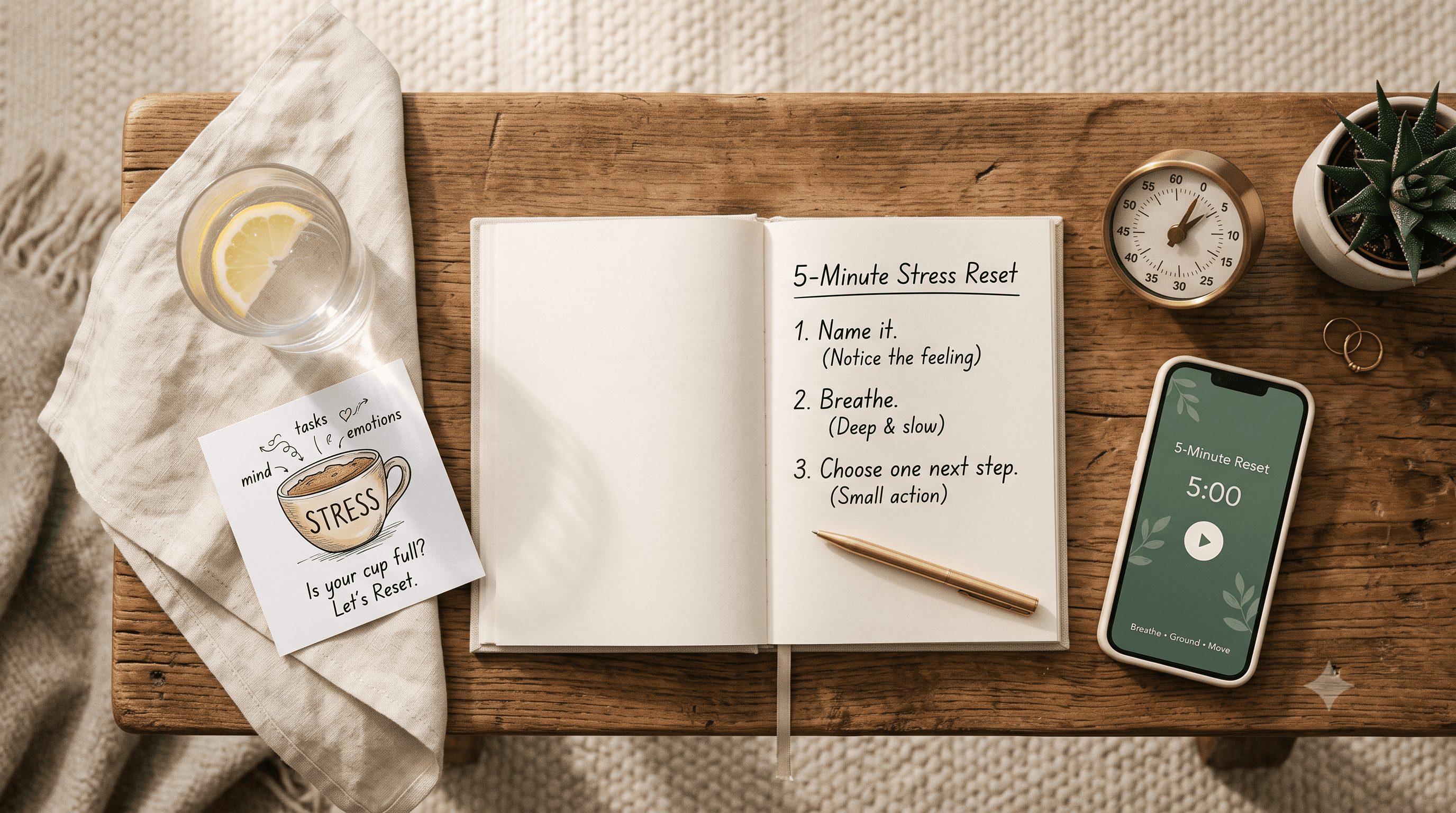
A 5-Minute Stress Reset I Built With — and Tested On — Myself
I built a 5-minute stress reset because I needed one.
Not in theory. Not as a cute little wellness concept floating around in the land of good intentions. I needed something I could actually use when my mind felt full, my body felt activated, and my to-do list started looking at me like it wanted a fight.
So I built a tiny reset inside The 30-Day Stress Reset app and tested it on myself.
Very scientific? Not exactly.
Useful? Surprisingly, yes.
The Goal Was Not to Fix Everything
I did not build this reset to solve every source of stress in five minutes. That would be wellness fantasy with a nice font.
The goal was much smaller: could I create a short practice that helped me pause, name what was happening, regulate my body a little, and return to my day with more clarity?
That felt realistic. And honestly, realistic is underrated.
A good stress reset does not need to erase your entire nervous system history. Sometimes it just needs to help you stop spiraling long enough to take the next kind, intelligent step.
Step 1: Name What Is Filling the Stress Cup
The reset starts with a simple question:
What is filling my stress cup right now?
I used the Stress Cup idea because stress often feels vague until we name it. Once I identify the specific stressors — deadlines, poor sleep, relational loops, decision fatigue, too many tabs open in my brain — the experience becomes less foggy.
Naming the stress does not make it disappear.
But it gives the mind something to work with.
In the app, the Stress Cup Visualization turns that invisible load into something visible. For me, that was helpful because I could stop saying, “I’m just overwhelmed,” and start saying, “Oh, these are the three things taking up the most room.”
That shift matters.
Step 2: Slow the Breath Before Solving the Problem
After naming the stress, the reset moves into breathing.
I chose this because breathing is one of the simplest ways to create a pause between activation and reaction. Relaxation techniques can include practices such as deep breathing, guided imagery, progressive relaxation, and similar approaches, and NCCIH notes that some evidence suggests relaxation techniques may help with stress-related symptoms, though the evidence varies by practice and population.
For this reset, I kept it simple:
Breathe in slowly.
Breathe out longer than you inhale.
Repeat for a few rounds.
No complicated performance. No “breathe perfectly or start over.” Just enough rhythm to remind my body that we were not, in fact, being chased by a lion — unless the lion is email, in which case, emotionally yes.
Step 3: Choose One Tiny Next Step
Once I had named the stress and slowed my breathing, I asked one more question:
What is one small thing I can do next?
Not everything.
One thing.
That might be drinking water, answering one email, stepping away from the screen, writing down a worry instead of rehearsing it, or deciding to handle something tomorrow when my brain is not wearing tap shoes.
This part matters because stress often tricks us into thinking we need a complete life overhaul. Sometimes we need a single next step.
That is the psychology behind the reset: reduce overload, restore a little agency, and make the next action small enough to begin.
What I Noticed When I Tested It
When I tested the 5-minute reset on myself, I did not suddenly become a glowing wellness oracle.
But I did feel a little more organized.
My body felt less rushed. My thoughts felt less tangled. The stressors did not disappear, but they became more separate from me. That made them easier to approach.
The most helpful part was the sequence:
Name it.
Breathe with it.
Choose one next step.
That rhythm gave my mind something constructive to do instead of letting stress drive the whole car with one hand on the horn.
Why I Built It Into the App
The 30-Day Stress Reset is built around tiny practices because overwhelmed people do not need complicated wellness homework.
They need a doorway.
A small practice.
A gentle re-entry point.
That is why the app includes daily reset practices, the Stress Cup Visualization, breathing tools, reminder anchors, and reflection space. Each piece is designed to help the user notice their signals and practice responding with more care.
Good wellness technology should not make people feel like they failed at being calm.
It should help them practice calm in small, believable ways.
What This Does—and Does Not Mean
This 5-minute reset is a wellness practice, not a clinical treatment.
It may support everyday stress management by helping someone pause, breathe, reflect, and choose a small next step. NCCIH describes stress management approaches such as deep breathing, guided imagery, progressive relaxation, meditation, yoga, and other mind-body practices, while also emphasizing that people should seek appropriate care when stress is severe, persistent, or connected to medical or mental health concerns.
My personal test is not proof that the reset will work for everyone.
It is a starting point.
A tiny experiment.
A way to build, try, notice, revise, and keep making the tool more useful.
The Bigger Lesson
Building this reset reminded me that wellness apps do not need to start with giant features.
They can start with one honest moment:
I feel stressed. What would help me take care of myself for the next five minutes?
That question is enough to build around.
And maybe that is the heart of the whole project.
Not perfect calm.
Not dramatic transformation.
Just small resets that help us return to ourselves, one practice at a time.